
The Backlash Against Digital Feminism
By DAISY CHAPMAN - 9 Dec 2025
In recent years, global conversations about gender have been marked by both progress and polarisation. While feminist movements have expanded across digital and physical spaces, they have simultaneously been met with, and exposed, significant backlash. This pushback, led primarily by disaffected men and legitimised by a new digital ‘manosphere’, reflects a growing crisis of masculinity with serious social and political implications, as well as severe impacts on women's rights and freedoms.
THE ‘BOY CRISIS’ AND THE MAKING OF THE MANOSPHERE
The so-called ‘crisis of masculinity’ has become a prominent discourse across social media, politics, and education, often used to describe male underachievement, mental health crises, and loneliness, among others, in modern society. Amid huge structural shifts in gender roles, traditional or ‘normative’ masculinity, once anchored in physical strength, economic dominance and social authority, has lost the stability that provided men their means of ‘superiority’ for so many years. In this new social context, many young men seek belonging and purpose in online communities that promise empowerment but instead produce and intensify misogyny.
Within this context, figures such as Andrew Tate have risen to dominance, building lucrative online communities that valorise aggression, sexual dominance, and contempt for women and feminism. Tate’s influence, reaching millions of adolescent boys and young men through social media algorithms, exemplifies how disillusionment along with digital spaces and engagement converge to form an ecosystem of hate and violence. These online spaces, often described collectively as the ‘manosphere’ function as echo chambers where men’s frustrations are reframed as evidence of female privilege and feminist oppression.
The consequences of such ideological radicalisation have proven time and again to cause real world violence to women and girls, and in some cases have proven deadly. Now, more than a year on from the tragic murders of Carol, Louise and Hannah Hunt, their killer Kyle Clifford will die behind bars. In March 2025, Clifford was sentenced to a whole-life order for the premeditated attacks, in which he stalked, raped, and murdered his ex-girlfriend with a crossbow, along with her sister and mother. Subsequent investigations revealed that, in the night prior to the attacks, Clifford had searched for and watched content by Andrew Tate.
Threats of sexual violence, harassment, and coordinated attacks have become a normalised way to punish feminist expression and to reassert patriarchal norms.
POP CULTURE AND THE MAINSTREAMING OF THE MASCULINITY DEBATE
In mid-2025, these issues reached a new level of visibility with the release of Netflix’s record breaking series Adolescence, starring Owen Cooper and Stephen Graham. The show focuses on how impressionable young boys can be radicalised by online creators who promote gender wars, misogyny, and narratives of male biological superiority.
Adolescence sparked an unprecedented wave of public conversation, praised for shedding light on the digital radicalisation of men and boys, and the societal failures enabling it. UK Prime Minister Keir Starmer backed Netflix’s proposal to have the drama shown for free in secondary schools across the country, and claimed that it had “...hit home hard” when he had watched the show with his teenage son and daughter. Yet, as with so many cultural moments centred on women’s rights and male perpetrated violence, its impact was met with a familiar pattern of backlash. Online, a flood of misogynistic commentary emerged, denying the realities of violence against women and girls, dismissing systemic gender inequality and reframing the show as ‘man hating’ or ‘misandry’. Once again, the depiction of harm being inflicted as a result of these ideologies, and women’s attempts to tell their stories in response to it, were met with accusations of bias, exaggeration, or ‘hatred of men’. The cycle of backlash persisted: visibility invited denial, and exposure of misogyny provoked its resurgence.
DIGITAL FEMINISM AND THE ECONOMY OF BACKLASH
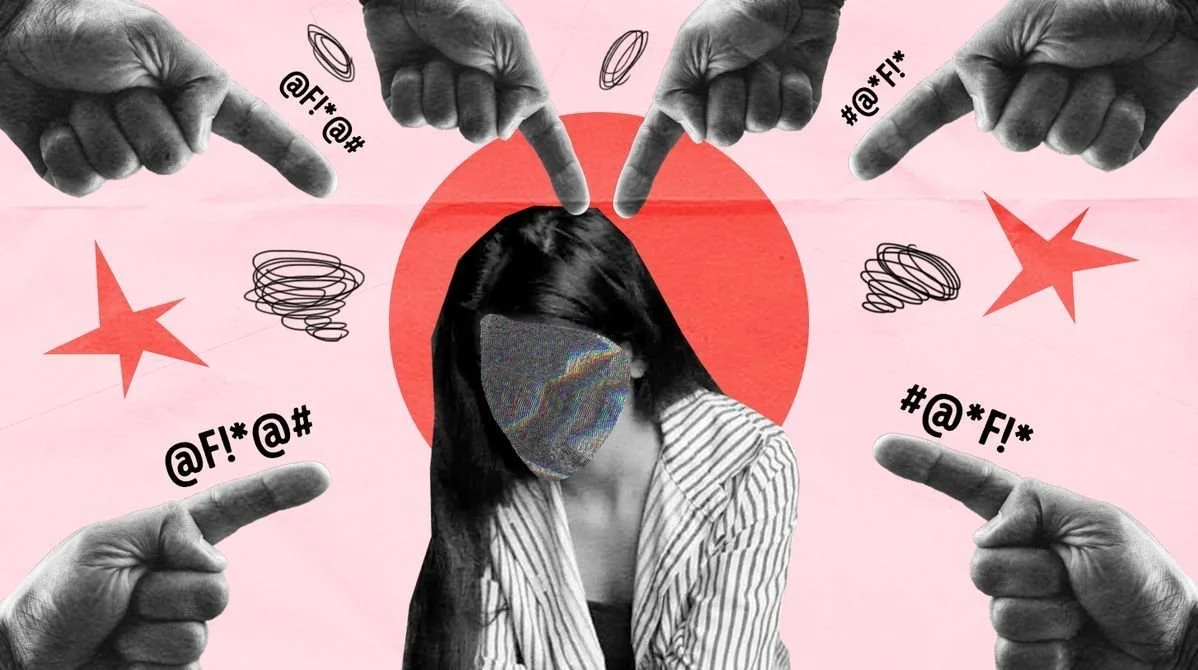
As women increasingly use digital platforms to share experiences and advocate for gender equality, their voices are often met with malevolence. Online abuse functions not just as random trolling, but as a deliberate form of gendered retaliation seeking to silence women who speak in public spaces. Threats of sexual violence, harassment, and coordinated attacks have become a normalised way to punish feminist expression and to reassert patriarchal norms.
In 2013, British journalist and activist Caroline Criado-Perez ran a successful campaign to have renowned English author Jane Austen represented on the UK’s £10 note, what followed was a campaign of targeted online hatred, death and rape threats, and stalking. Criado-Perez stated that she received her first threat the day after the decision was announced by the Bank of England. Most of these threats came from men and consisted of explicit detail of the sexual violence that they intended to inflict upon her. In Criado-Perez’s own words “This descended into two and a half weeks of continual rape and death threats. They were incredibly graphic, incredibly violent and very specific about which parts of my body were going to have what happened to them - very gruesome things that were being suggested”. These explicit and dangerous reactions to women sharing their achievements or opinions online have, according to Jane (2014, p. 535), “become the modus operandi for those wishing to critique female commentators”.
In recent years, misogynistic abuse and violence in online spaces have escalated sharply, particularly in reaction to women’s visibility and activism on social media. The growing influence of far-right ideologies, alongside figures like Andrew Tate who legitimise and provide justification for such hostility, suggests that these attacks are likely to become even more frequent. As a result, women who share feminist views online, and by extension in their offline lives, face mounting risks of harassment and violence framed as “punishment” for speaking out. UN Women states that online misogyny is rising to such an extent, that it has reached ‘crisis levels’.
This trend, referred to as ‘feminist digilantism’ by Jane (2016, p. 285), describes the growing practice of women’s rights advocates publicly and ‘naming and shaming’ those responsible for misogynistic abuse, and actively pushing back against harassment in digital spaces. Rather than remaining silent or relying solely on platform moderation or legal remedies, activists use social media itself as a tool of accountability. Tactics often include exposing abusive messages, identifying perpetrators, reporting harmful content en masse, or rallying online communities to demand consequences. For many, these actions provide a sense of agency in environments where abuse is frequent and official responses are slow or ineffective. At the same time, ‘feminist digilantism’ challenges the traditional boundaries of justice by shifting power back to victims and supporters, creating public records of abuse and signalling that misogyny will not go unanswered. In turn, online reactions are frequently defined by open hostility and misogyny. Research highlights that women who express feminist views on social media are often subjected to deliberate abuse, with some scholars identifying this as a new form of violence against women and girls. In one study, 88% of regular Twitter (X) users who participated in feminist discussions reported experiencing abuse. Some respondents described receiving explicit sexual images, while others had personal photos, or images resembling them, circulated to friends and family as a means of intimidation (Lewis et al., 2016).
Additionally, in April 2025, Australian grassroots organisation Collective Shout began a campaign and petition to online game stores Steam and Itch.io, to remove a game named ‘No Mercy’, which it described as a 3D pornographic rape/incest simulation game. The content included alleged non-consensual sex, rape of female family members as ‘punishment’ etc. The game was blocked after complaints by Collective Shout to regulators like the Australian Classification Board, and eventually the developer removed the game globally. Following this, Collective Shout claimed to have found upwards of 500 games on Steam and Itch.io that were tagged with rape, incest and child abuse themes. Collective shout published an open letter to payment processors (MasterCard/Visa), asking them to stop facilitating the abuse of women and children through the purchase of games with these themes. Steam updated its policies and removed almost all of the offending games. Following this, the women campaigners from Collective Shout were subjected to horrific sustained abuse and threats of violence. The threatening messages included “you f...ed with gamers, now we are going to rape you” and “I’ll cut off your heads and f*** your corpses,”, along with the use of deep fake porn (the act of superimposing a person’s likeness into pornographic depictions, often using AI) as a further means to dehumanise the women who pioneered the removal of abusive games.
Online and offline abuse of women engaging in feminist debate/discussions persists as an extended form of everyday violence against women and girls, however the relative anonymity provided by social media accounts and online websites allows for perpetrators of abuse to remain unaccountable and lacks almost any current legal framework to bring victims justice. Online abuse that is underlined by ideological hatred and misogyny often seeks to sexually degrade and violate women. Graphic pornographic depictions, cyberflashing, threats of rape, sexual assault and murder, all utilised by perpetrators who begin their abuse in online spaces, are all used to intentionally punish women for voicing their opinions or expressing disagreement or anger at cultural norms and acts of sexism.
Online abuse acts as a tool with which to regulate or silence women who are activists or outspoken in any way.
REAL WORLD HARM AND THE FAILURE OF MAINSTREAM RESPONSES
Online misogyny and real world violence are increasingly intertwined and the boundary separating between digital hostility and physical harm is becoming dangerously thin. Online platforms serve both as sites of radicalisation and rehearsal spaces for violence. Perpetrators like Kyle Clifford, steeped in manosphere ideologies, translate that digital hate into physical acts of control, punishment, and annihilation. Feminist scholars call this a continuum of gendered violence, stretching from online harassment to intimate partner abuse and femicide. Each instance reaffirms patriarchal authority by silencing women and policing their agency, while online ‘thought leaders’ validate and inflame men's resentment. Thus, the digital sphere has become a battleground over the legitimacy of feminist speech itself.
Until the public reckoning prompted by Adolescence, mainstream institutions had largely failed to address the social roots of the crisis. Rather than confronting the systemic underpinnings of misogynistic attitudes, or the growing isolation and rigid gender expectations shaping men’s lives, policy and media debates often oscillate between denial, moral panic, and outright gender and culture wars. This failure has consequences for both men and women. For men, it cultivates alienation, emotional suppression, and susceptibility to radicalisation. For women, it sustains environments of hostility, allows abuse to continue, and maintains a constant threat of violence. Addressing this issue requires more than just condemning sexism and misogyny; it means rebuilding and rethinking what masculinity stands for, in ways that decouple men’s strength from physical dominance, and vulnerability from weakness.
Collective Shout. (n.d.). Gamers abuse our team – media coverage [Web page]. Collective Shout. https://www.collectiveshout.org/gamers-abuse-our-team-media-coverage
Fullbrook, D. (2025, March 11). Crossbow killer jailed for life for triple murders. BBC News.https://www.bbc.co.uk/news/articles/cg70vjmv08ro
Hoge, W. (2013, October 9). Rape threats on Twitter greet England’s new bank note: Interview with Caroline Criado-Perez. IPI Global Observatory. https://theglobalobservatory.org/2013/10/rape-threats-on-twitter-greet-englands-new-bank-note-interview-with-caroline-criado-perez/
Jane, E. A. (2014). “Your a ugly, whorish, sl*t”: Understanding e-bile. Feminist Media Studies, 14(4), 531–546. https://doi.org/10.1080/14680777.2012.741073
Jane, E. A. (2016). Online misogyny and feminist digilantism. Continuum, 30(3), 284–297. https://doi.org/10.1080/10304312.2016.1166560
Lewis, R., Rowe, M., & Wiper, C. (2016). Online abuse of feminists as an emerging form of violence against women and girls. The British Journal of Criminology, 57(6), 1462–1481. https://doi.org/10.1093/bjc/azw073
Prime Minister’s Office, 10 Downing Street. (2025, March 31). Downing Street opens doors to Adolescence creators for vital discussion on protecting our children [Press release]. GOV.UK. https://www.gov.uk/government/news/downing-street-opens-doors-to-adolescence-creators-for-vital-discussion-on-protecting-our-children
UN Women. (2025, May). The manosphere is no joke: UN Women explains why [Media advisory]. UN Women. https://www.unwomen.org/en/news-stories/media-advisory/2025/05/the-manosphere-is-no-joke-un-women-explains-why
UN Women. (n.d.). Digital abuse, trolling, stalking and other forms of technology-facilitated violence against women[FAQ]. UN Women. https://www.unwomen.org/en/articles/faqs/digital-abuse-trolling-stalking-and-other-forms-of-technology-facilitated-violence-against-women
Vaughan, H. (2025, March 6). Kyle Clifford: Violent misogyny of kind promoted by Andrew Tate ‘fuelled rape and triple murder’, prosecution says. Sky News. https://news.sky.com/story/kyle-clifford-violent-misogyny-of-kind-promoted-by-andrew-tate-fuelled-rape-and-triple-murder-prosecutors-allege-13321891